
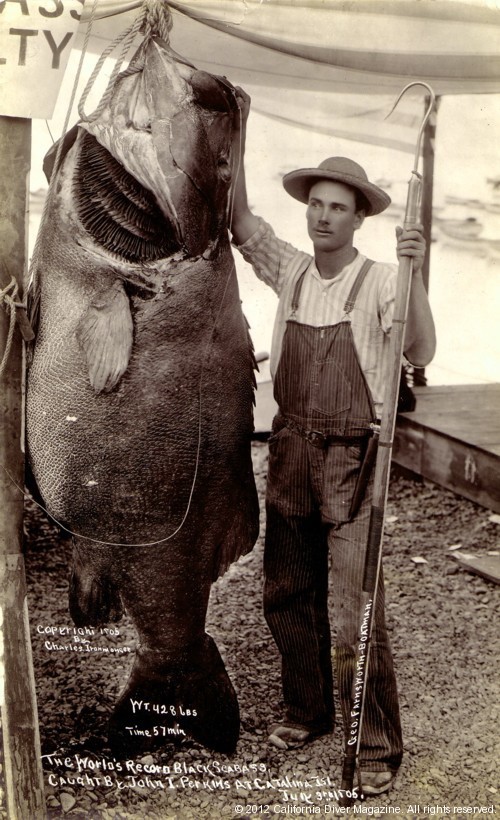
World’s record Giant Sea Bass, 428 pounds, caught by John I. Perkins on June 31, 1905 at Catalina Island.
Scott Andrew Carlton, 30, of Corona Del Mar was spear fishing on Friday night at approximately 7:30 p.m. at Salt Creek Beach at Dana Point in Orange County when he speared a state-protected giant sea bass, commonly called a black sea bass. A concerned citizen took a photo of the man and his catch, then notified a nearby CHP officer. The CHP detained Carlton, and notified DFG dispatch. Warden Justin Sandvig arrived and cited Carlton, who claimed ignorance of the law. Take of giant sea bass is a misdemeanor.
Prior to the 1950s, large numbers of giant (black) sea bass could be found in the waters off of southern California, but most of these large creatures were harvested for their value as photographic trophies. Known for their docile behavior, the slow-moving black sea bass resides mostly near the shoreline in deep rocky environments and can grow up to 500 pounds and seven feet long.
Ignorance of the law is no excuse, especially when poaching state-protected species, said Capt. Dan Sforza of DFG’s Law Enforcement Division. Giant (black) sea bass are cherished by many ocean enthusiasts because of their size and docile nature.
# # #
Note: This e-mail account is used to distribute information to the public. Do not reply to this e-mail; instead, direct questions or comments regarding the information contained in this e-mail to the Department staff listed as points of contact for this subject – thank you.
– Subscribe (or unsubscribe) to DFG Marine Region News Service (e-mail notification of ocean-related news and information) at www.dfg.ca.gov/marine/subscribe.asp .