Scuba diving is one of the most cognitively demanding recreational activities on the planet. Just scan a typical dive: finning, navigation, photography, mask clearing, hand signals, neutral buoyancy, sharing air, safety stops, checking gauges, flashlight handling, air monitoring, ear clearing, adjusting straps, opening and closing valves, staying close to your buddy, protecting coral, watching sea life, deploying a surface marker, controlled ascent, the giant stride, following the dive plan, managing emergencies, equipment failure — and, of course, having fun.
That mental load is powered by executive functioning, the cognitive umbrella that governs decision making, planning, impulse control, working memory, and personality expression. The pre-frontal cortex of the brain, specifically the frontal lobe which runs the show, while the parietal lobe processes touch, temperature, joint position, and proprioception: where your body is in space. For a diver hovering motionless above fragile coral, that’s not abstract neuroscience.
Executive functioning is also the cognitive system most worth protecting. A diver certified in their 20s might enjoy 50 years of a diving lifestyle. To stay competent and safe above and below we need to take care of body and mind.
Better Brains, Better Divers, Better Lives
The promise of training executive functioning reaches far beyond the dive boat. We can train our brains to resist the effects of aging, disease, and illness. In the process, we improve our health, our memory, our decision making, and our problem solving.
Improved executive functioning makes us better at activities of daily living such as shopping, managing finances, housekeeping, and self-care like eating, dressing, and personal hygiene. In other words, we can be better at life. Including planning vacations, setting up our dive gear, and being competent, safe divers above and below.
Executive functioning also improves most where the loss is greatest, which is precisely what happens with aging. That makes this work especially relevant for aging divers. Stronger executive functioning significantly enhances both learning and teaching with better focus, organization, task completion, and emotional regulation. Learners adapt to new information, switch between tasks, and solve problems more effectively. Working memory and inhibitory control often predict higher academic achievement more reliably than IQ. Learning and teaching are the lifeblood of our diving community.
And when something goes sideways underwater? Executive functioning is the only thing standing between you and the limbic system’s fight-or-flight panic response — the amygdala shouting “danger.” A trained brain stays in the frontal lobe long enough to solve the problem. Executive functioning is our superpower. Flawed and emotional as it can be, it’s unparalleled for survival and adaptation.
Multitasking vs. Dual-Tasking: A Critical Distinction
Here’s the part that surprises most divers.
Multitasking, performing two or more cognitive tasks at the same time, does not improve executive functioning. It feels productive, but it isn’t. Research suggests multitasking can drop productivity by roughly 40%, while raising stress and errors. The brain isn’t running parallel processes; it’s jumping rapidly between them, which slows overall completion and produces only a perception of higher performance.
Dual-Tasking is different and powerful. Dual-tasking pairs a physical or motor task with a cognitive task simultaneously, for different purposes. Think about finning while reading a compass. Dual-task training improves cognition better than physical training alone, especially in older adults. It strengthens connections across the brain, and the effects last longer than cognitive and physical training performed separately. Sound familiar? That’s basically a description of recreational diving.
Exercise Is the Real Brain Game
Crossword puzzles and brain games may modestly delay decline, but they show minimal measurable evidence of tangible cognitive improvement. Beyond mild cognitive decline, they can actually frustrate participants.
Physical activity, by contrast, is definitively shown to improve executive functioning both short-term and long-term. A 10- to 20-minute walk can immediately improve focus, cognitive flexibility, and working memory within hours, thanks to a complex muscle-brain communication loop. Metabolic changes triggered by exercise drive neurotrophic changes that improve brain health.
Over time, regular exercise improves overall health, delays aging, prevents illness and disease, and delays cognitive decline. Studies suggest that parts of the brain controlling thinking and memory show greater volume in people who exercise. Indirectly, exercise also improves mood and sleep and reduces stress and anxiety all of which contribute to cognitive impairment when unchecked.
Two complementary pathways matter:
- Aerobic exercise like running, walking, swimming, cycling primarily boosts factors that support new neuron survival and blood vessel growth.
- Strength training is more structural and especially effective at improving “top-down” cognitive processes like executive functioning and inhibitory (behavioral) control.
The benefits come from exercise’s ability to reduce insulin, reduce inflammation, and stimulate release of growth factors that support brain cell health, new blood vessels, and even new brain cells. Worth noting is that physical activity is nearly the only tool, alongside music and social interaction, which maintains connection in advanced cognitive decline.
Shoulder 90s + A Cognitive Task
This is a dual-task drill that fuses strength training with cognitive sequencing and memory consolidation.
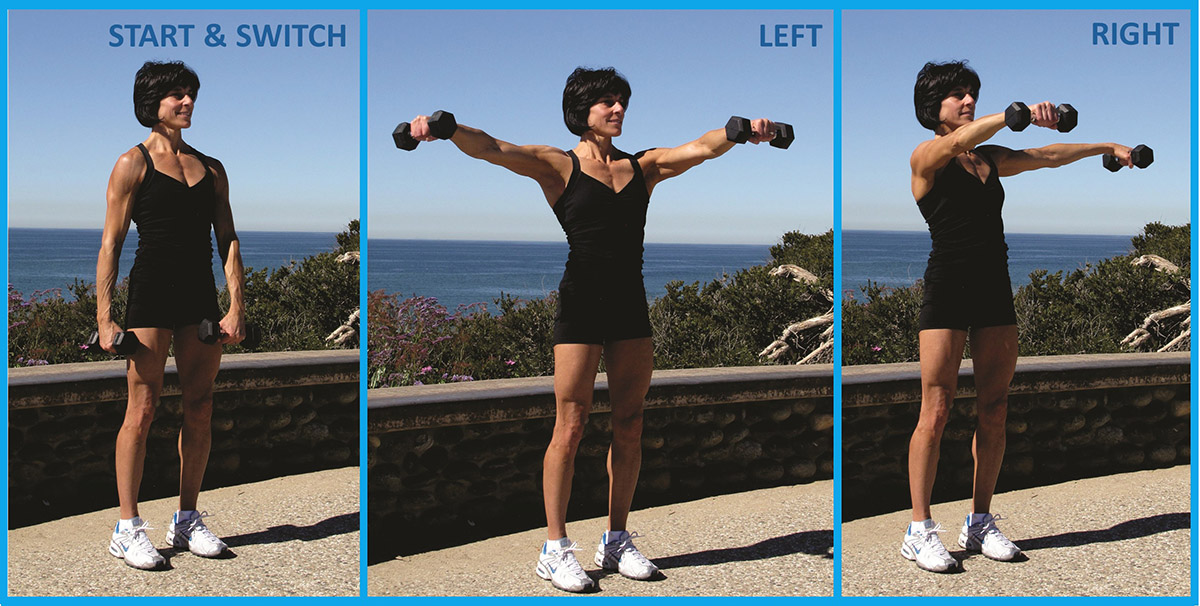
Movement and form:
- Begin with a light warm-up weight of 1 to 3 pounds.
- Alternate a front raise and a lateral raise — the “shoulder 90s.”
- 15 reps per side, 3 sets, 30-second rest.
- Controlled motion with no swinging.
- Elbow always higher than or level with the hands.
- Inhale at the start, exhale raising, inhaling lowering.
Add the cognitive layers:
- Name an ocean creature with each repetition: octopus, turtle, sea star, manta ray, whale shark…
- Start with 5 creatures, repeating until reps are complete.
- Add more creatures each workout, building memory consolidation which is the moment when short-term memory (3 to 8 items) flips to long-term memory through repetition, grouping, association, and meaning. The list should be easier to retrieve the next time.
It’s playful. It’s physical. It’s deeply diver relevant. And it trains the exact mental-motor coupling you use every time you reach for a gauge while keeping your buoyancy steady.
So, pick up a light pair of dumbbells. Run through your Shoulder 90s. Name your sea creatures. Walk on your surface-interval days. Lift on your dry days. Dive often. Take care of your body and your mind. The reef, and your future 70-year-old diving self will thank you.
Story by Gretchen T. Ashton
Gretchen Ashton is registered with the National Board of Fitness Examiners, an advanced and Nitrox certified diver, International Sports Sciences Association Elite Trainer, personal trainer, specialist in fitness therapy, specialist in fitness nutrition, and world champion athlete. Gretchen is a co-author of the ScubaFit® Diver Specialty Course and is an Expert Speaker for Los Angeles County Scuba Advanced Diver Program and Underwater Instructor Certification Course. As an athlete she set 21 World and Americans records and was the second woman inducted into the AAU Power Lifting Hall of Fame.