Programs to orient children to diving begin as early as seven years of age. While there is some variation among industry experts about the best age and responsible participation, it appears children are entering the sport of recreational scuba diving in greater numbers. Like adults, children need to be certified and fit to dive. The type of physical exercise appropriate for children is different than for adults. Changes in exercise protocol occur with age and individual health and physical development.
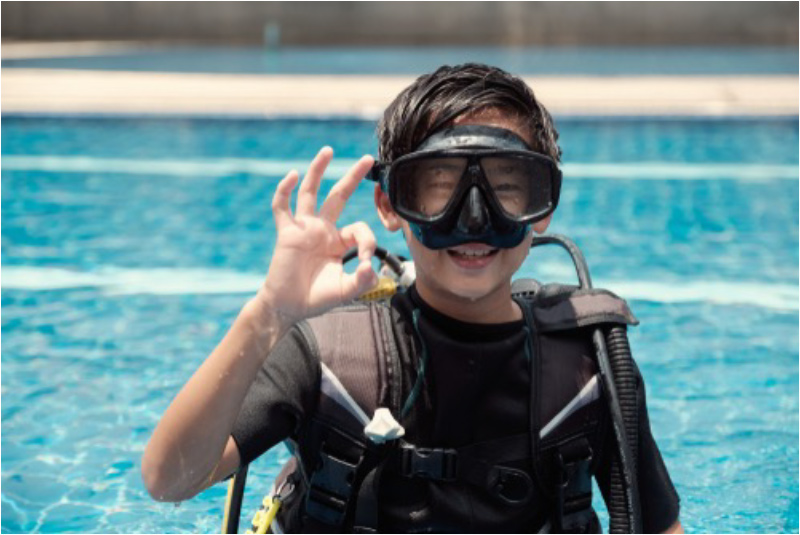
Photo credit: Shutterstock
When can young divers begin lifting weights as part of a fitness for diving program?
Most studies recommend children can safely begin lifting weights at about 13 years of age. These studies are primarily concerned with proper skeletal development in children and state that it is very important to NOT lift HEAVY weights at a young age. However, in my experience, because each child grows differently, exercise with weights may begin at any age. Each child will develop strength, control, and mental focus at their own pace. What is heavy weight for one child may be light weight for another. There is considerable evidence that competitive weightlifting can be safe for a healthy well-trained child.
Story by Gretchen Ashton, ScubaFit
I’ve discovered when introducing weight training programs for children that muscle tone and strength develops well in advance of the body’s ability to maximize it. The good news is that if trained well, when a child who lifts weights reaches puberty, their strength to weight ratio and sports performance ability dramatically improve in contrast to children who have not exercised with weights.
Whether a child lifts weights is best decided by the parents, not a coach or family friend. Like scuba diving for young divers, weight training for children should always be supervised and proper technique practiced with consistency until it becomes second nature.
One of the greatest benefits from strength training for children is an improvement in self-confidence. Learning to control the body helps young divers feel good and prevents some of the awkwardness experienced during the growing years. Free weights such as dumbbells are a good choice for young divers because they provide more functional exercises. Well-rounded training includes body weight workouts such as calisthenics and plyometrics combined with sessions of resistance training. This helps develop strength, coordination and balance that transfers well into recreational activities like carrying scuba gear, moving around on a boat, buoyancy control, and overall comfort in the water.
Scuba diving can be great motivation for exercise participation. Exercise sessions should be fun, educational, and designed for the specific needs of each child. Young divers in particular benefit from exercise in the form of youth sports participation and games such as “Sharks and Minnows”, a form of tag on land or in a pool, which engages both the mind and body.
Dive theory, fish identification, swimming skills and more, can be incorporated into a fitness program to help young divers learn to dive, gain a better understanding of personal responsibility, and participate more safely in the recreational activity of scuba diving.
Words & Photos by Gretchen Ashton, ScubaFit
Image details
Asset id: 1408092080
Preteen tween beginner scuba diver boy making ok hand sign, underwater communications, kid summer outdoors adventure activity, preteen travel
Release information: Signed model release on file with Shutterstock, Inc. Licensed by Gretchen Ashton, ScubaFit