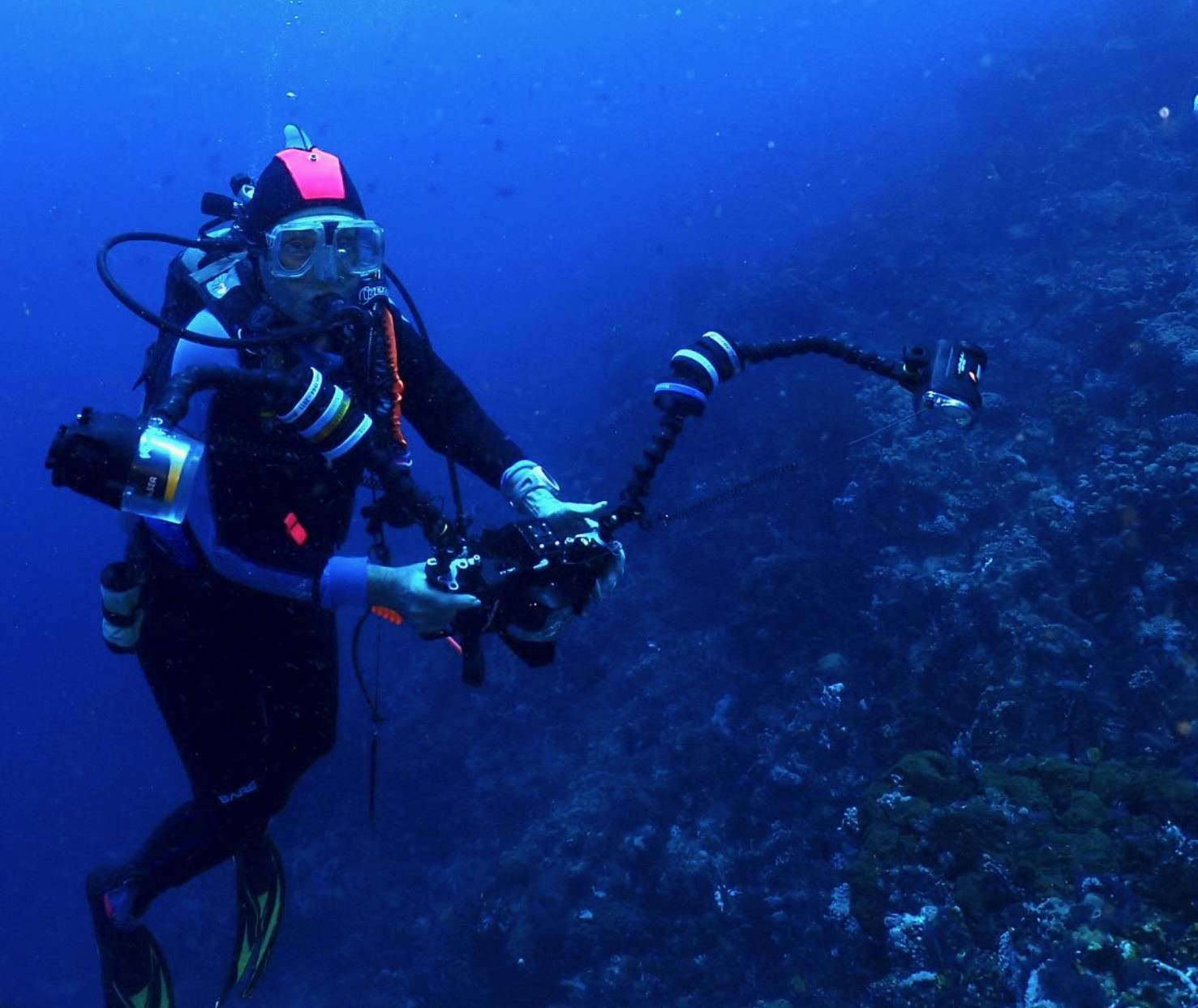
Bonnie McKenna is an award‑winning photojournalist and lifelong diver whose career and passions reflect a deep curiosity about the world. She is a member of the North American Travel Journalists Association (NATJA), the International Travel Writers Alliance (ITWA), and the Texas Photographic Society (TPS). A lover of science and a fitness enthusiast, Bonnie inspires others with her enduring connection to the ocean.
“Stay healthy so you can continue to enjoy our beautiful world.”
– Bonnie McKenna
Bonnie took her first open‑water dive in 1955 at the age of fourteen in La Jolla, California. At the time, scuba equipment was minimal by today’s standards—no wetsuit, no buoyancy control device, a J‑valve tank, a double‑hose regulator, and fins that felt incredibly heavy. She immediately fell in love with the underwater world, never imagining that she would still be diving more than seven decades later.
How did you come to take your first open‑water dive at such a young age?
I was living at the Masonic Home for Children in Covina at the time. The superintendent, Robert Henry, was always coming up with activities for us. We had a large swimming pool, and I was naturally drawn to anything involving the water. I don’t know what inspired Mr. Henry to learn scuba diving himself and become certified through the YMCA, but when he announced that he would teach anyone who wanted to learn, I raised my hand immediately.
What was it like diving in La Jolla, California, in 1955?
What stands out most in my memory is seeing the beautiful garibaldi and the kelp forests. Looking back as an adult, I imagine the water must have been cold, but we were constantly body surfing back then, so it didn’t really make much of an impression.
Diving gear was pretty basic in those days. What was it like using that type of equipment?
I didn’t think much about it at the time because I had nothing to compare it to. Jacques Cousteau used the same kind of equipment, so it seemed perfectly normal to me.

You’ve traveled extensively around the world. Was diving a major focus of your travels?
Between high school and college, I didn’t dive much. During my time as a Peace Corps volunteer in Thailand from 1962 to 1964, I went diving several times. I wouldn’t say diving was the primary focus of my travels, but whenever the opportunity came up, I took it. That changed after I became certified in Fiji in 1981.
You just returned from a diving in the Maldives. How would you describe this diving adventure?
I went to the Maldives specifically to see the sharks; Tigers and Hammerheads. Although the sharks (Tigers) are chummed, it does not detract from the opportunity to marvel at their strength and beauty. No photo does justice to their magnificence. Unfortunately, we did not see any Hammerheads. Due to the popularity of the Tigers, diving in the area is time-regulated, so the area is not overwhelmed with hundreds of divers at once.
I also spent five days on a liveaboard. I enjoyed seeing the beauty of the reefs, but the Coral Triangle of the Indo-Pacific will remain my favorite. I had a good laugh, too; it was announced that I was the oldest diver they’d ever had on board. Yeah!!!!!
You’ve been diving for more than 70 years. Did you ever imagine that first dive would turn into a lifelong passion?
No, I didn’t. But I’ve always been interested in science, and diving became a natural extension of that curiosity—another way to see, explore, and learn about the sea.
How does it feel to realize you’re still diving after all these years?
It feels great, especially now. I have more leisure time to enjoy diving and to spend time with people who love it as much as I do.
You’ve mentioned that regular exercise has helped keep you in the water. What motivates you to stay active?
I’ve always been physically active; it’s simply part of who I am. I believe exercise keeps you strong, both physically and mentally. To quote from an article I recently read: “One minute of exercise correlates to five extra minutes of life (on average).” The Stanford research discussed how exercise provides benefits at the cellular level.
Is there a particular type of exercise that helps you stay in shape for diving?
I believe weight‑bearing exercises tend to keep the body stronger.
Do you have a message for other divers?
Stay healthy so you can continue to enjoy our beautiful world.
–––––––––––––––––––––––––––––––––––––––––––––––––––––––––
Story by Gretchen M. Ashton, CFT, SFT, SFN, SSC, NBFE