
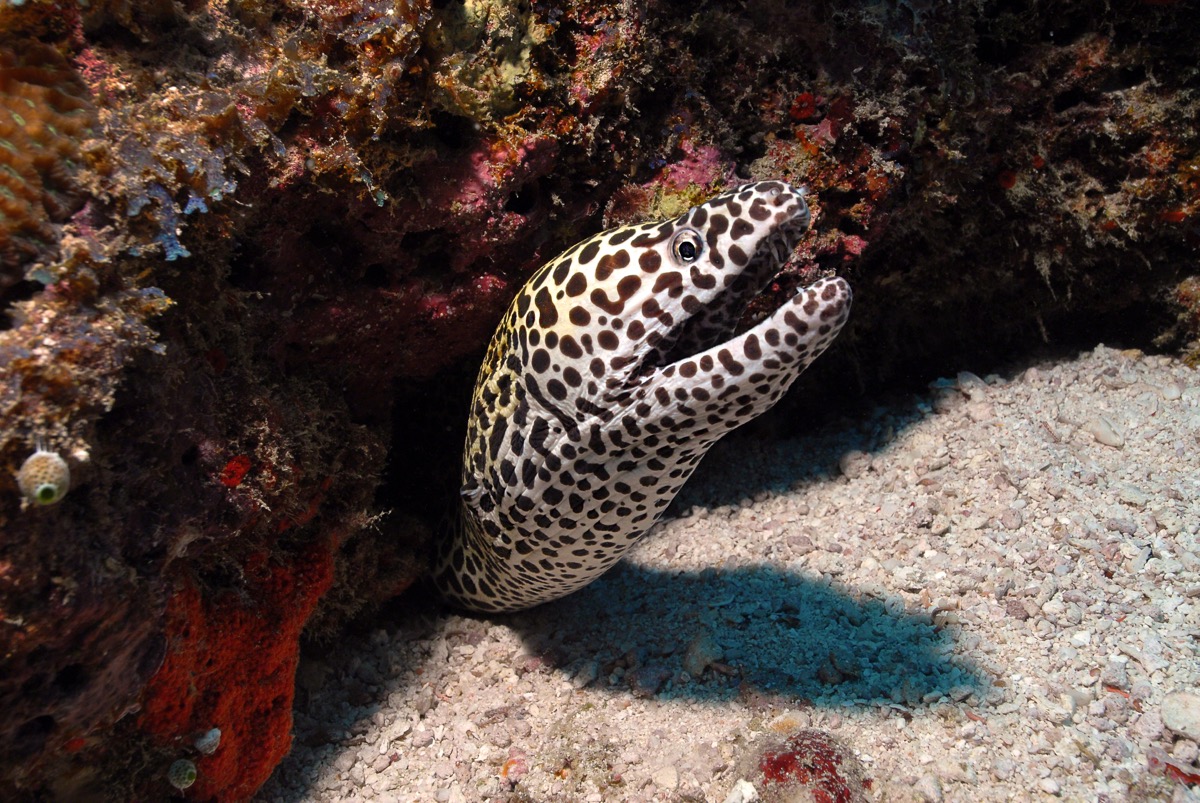
The Honeycombed Moray from the Maldives is a strikingly beautiful creature
“When the moon hits your eye like a big pizza pie, that’s amore,
when the world seems to shine like you had to much wine, that’s amore”
Those are the famous opening lyrics to the song “That’s Amore”, written in 1953 by Harry Warren and Jack Brooks and performed by Dean Martin. But we have a different version, inspired by one of the more mysterious reef dwellers that many divers have encountered but that few have fully understood:
“When the eel slithers by which we spot it with our eyes, That’s a Moray!
When he hides in a cave and stares back with its gaze, That’s a Moray!”
There are approximately 200 species of Moray Eels, the vast majority of which inhabit the world’s tropical oceans. A few species can exist in freshwater environments and several are found in temperate waters but most divers encounter these creatures in warmer waters in reef ecosystems. Although they are somewhat ubiquitous in these environments, divers never fail to get excited when one is spotted. Let’s examine some of the little-known aspects of this fascinating creature.
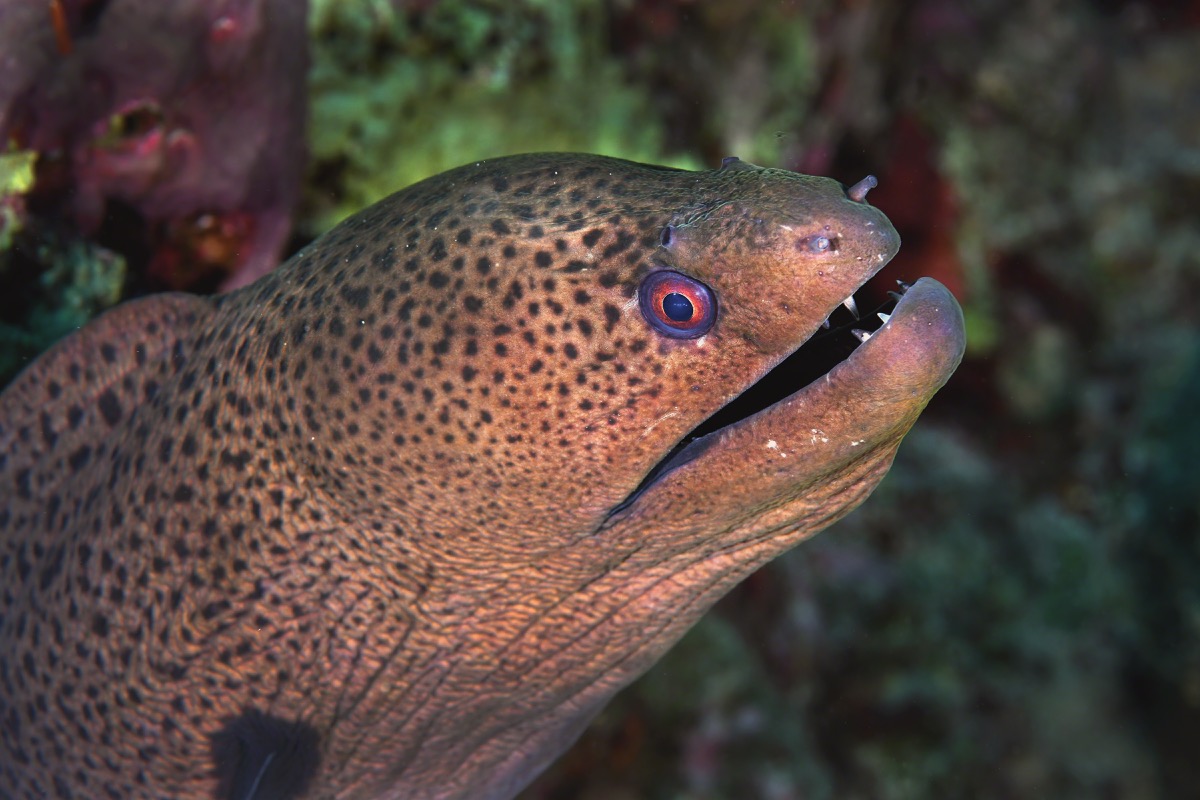
As its name implies, the Giant Moray from the Red Sea is the largest Moray Eel
Moray Eels are actually slender, bony fishes that can be found in a wide variety of sizes, colors and patterns. Some are as small as 6 inches while others may grow to 15 feet in length. They are predators and occupy an important part of the food chain by helping cull weak, dead or dying fish, octopus and crustaceans from the reef. It is believed that some individuals may survive for 30 years or more.
Anatomically, these eels have a thick skin which lacks scales. Most species have a low dorsal fin and lack pectoral or pelvic fins. And for fans of the science fiction movie “Alien”, it is interesting to note that Moray Eels have a second set of jaws, known as a pharyngeal jaw, contained in its throat. When the moray bites its prey, it first bites normally with its oral jaws, which captures the prey. Then, the pharyngeal jaws are brought forward to bite down on the prey in order to grip it more firmly. The eel then retracts this second set of jaws, pulling the prey down the moray eel’s gullet, where it is swallowed.
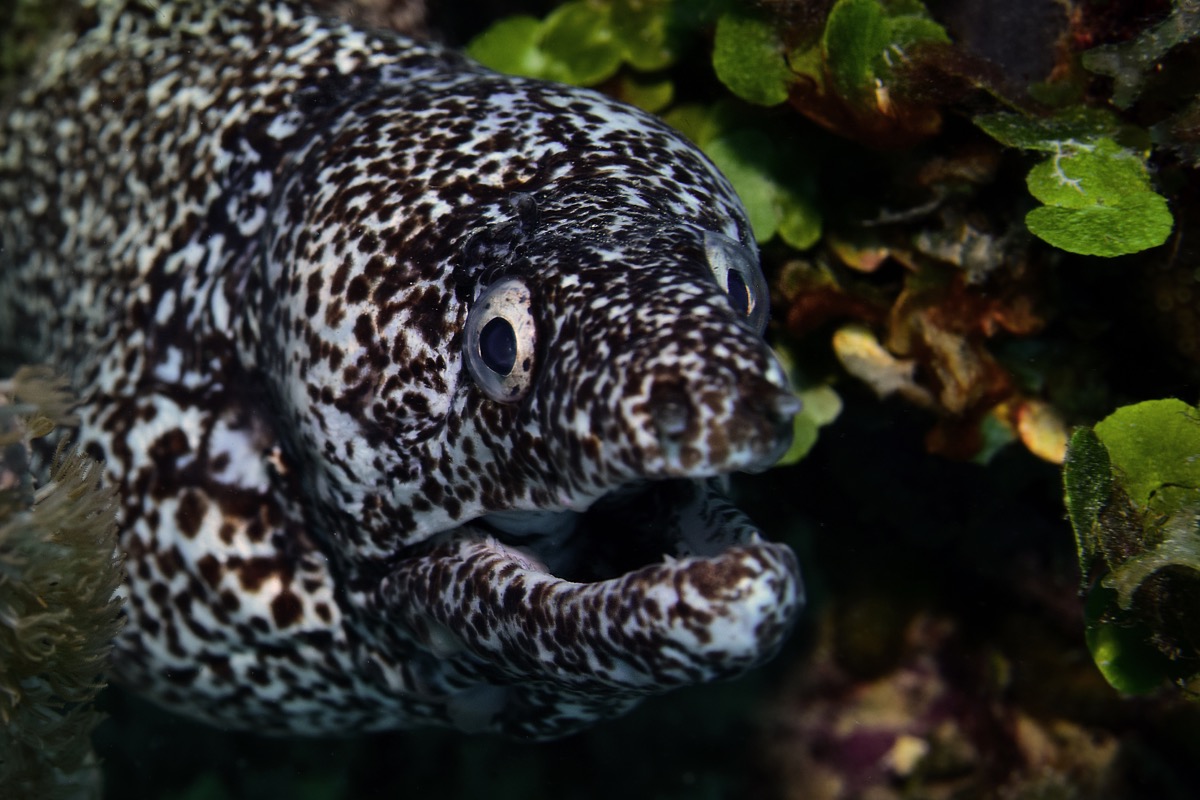
This Spotted Moray Eel from the Dominican Republic is trying to look ferocious
Terrifying indeed!
Although many divers encounter Moray Eels while they are backed into a crevice in the reef, their head facing out in a menacing pose, Moray eels are no threat to divers unless provoked. They are often seen staring right at passing divers, even though their eyesight is considered to be poor. And they continually open and close their mouths, which exposes their needle-sharp teeth but this is not a threat display. Rather, the eel is simply breathing. This is a process known as a buccal pump, which forces water over their gills to extract oxygen. Unlike many other fish that have external gill covers, morays lack these, which is why they must continuously open and close their mouths to create water flow necessary for respiration. Biologists also believe that this action may help with temperature regulation and may also be used to flush the eel’s gills, keeping them clean.
Words & Photos by Michael Salvarezza & Christopher P. Weaver
While divers do not need to fear Moray Eels, it is important to be careful. Do not attempt to touch, hold or harass or Moray Eel. Also, do not stick your finger or hand into any hole, crevice or crack in the reef. If a Moray is inside, it will bite to defend itself. Even resting your hand near the entrance to the Moray’s lair may result in a bite.
Moray Eels do not have venom. Should a diver be bitten by a Moray Eel, the major risk would be from infection. If a bite occurs, get it treated immediately.
Not so terrifying!
Because most moray eels have low dorsal fins and don’t have pectoral and pelvic fins, they do not have a great amount of lateral stability. It is not uncommon to see moray eels lying or drifting on their sides or even posing upside down. They may appear dazed, sick, clumsy or dying…none of which is likely as they just have some trouble keeping stable.
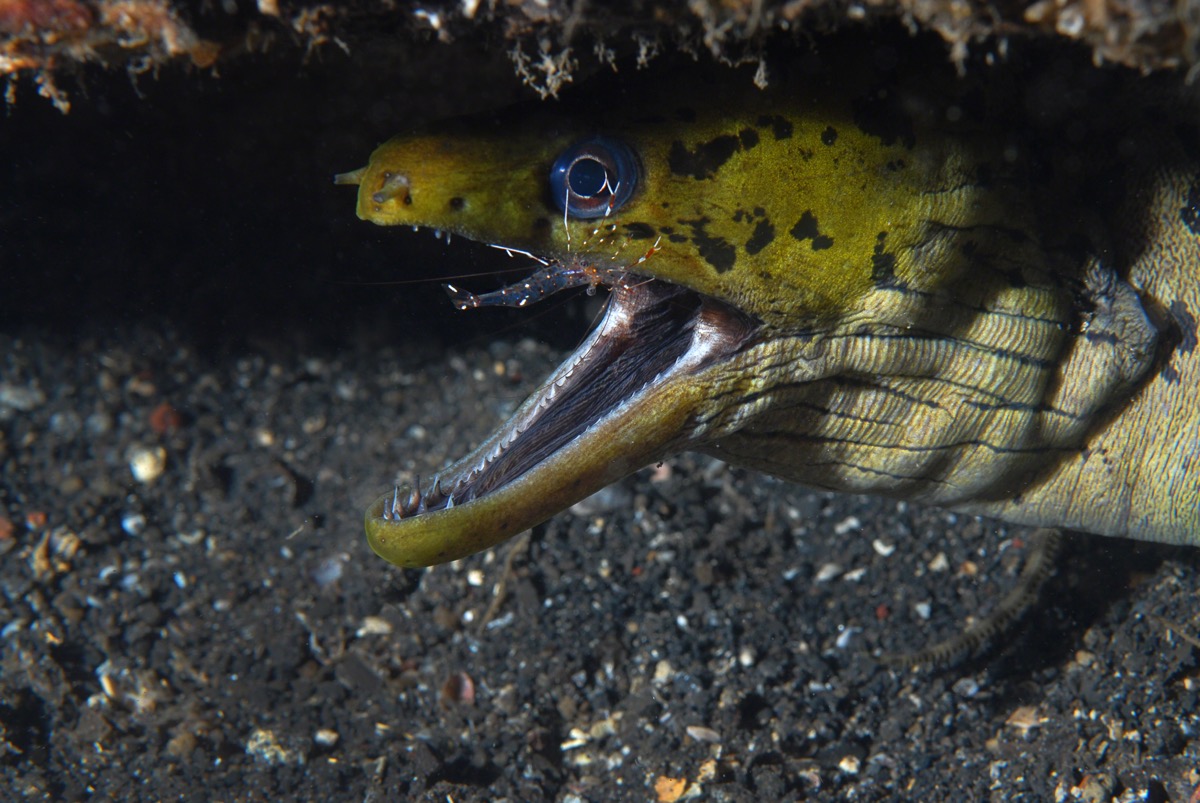
This Fimbriated Moray is enjoying a dental cleaning from a Cleaner Shrimp
Amusing!
Moray eels are primarily nocturnal hunters. Most will spend the daytime hiding in crevices or holes in rocks and reefs. Scientists believe that Morays hunt at night due to their poor eyesight, relying more on their sense of smell to find prey, and to take advantage of the increased activity on the reefs at night. Divers will see Morays out during the day, but this is usually attributed to the eel looking for a new spot on the reef to hide. However, one fascinating aspect of Moray eel behavior is its ability to cooperate with other species while hunting.
Scientists have repeatedly observed Moray Eels and Groupers working together to capture prey. This form of inter-species cooperation is exceedingly rare in the animal kingdom. Grouper apprehend prey in the open water while Moray Eels trap their prey inside the reef. In this form of teamwork, these opposing hunting strategies work when paired together: fish fleeing a Grouper in the open water will seek refuge in the reef. Fish trying to escape a Moray Eel will seek open water. The two styles of predation work to doom the fish!
When a Grouper spots a fish darting into the reef to hide, it swims over to the nearest moray eel. It notifies the eel by shaking its head and waving its dorsal fin. The eel will often respond to the Grouper’s signals by leaving its crevice and following the grouper to where the prey is hidden. Once in front of it, the grouper repeats the same dance to let the eel know the prey is close and the eel will dart into the reef in search of the prey. If the eel successfully captures the fish, the Grouper is out of luck. But the Grouper waits patiently, hoping the eel will not catch its meal and will merely flush it out into the open water. When that happens, the Grouper wins.
Intelligent!
Some moray eels actually change gender during their life in a process known as sequential hermaphroditism. Not all species of Morays perform this miracle of nature, but those that do use this as a reproductive strategy influenced by factors like age and population needs. For example, if there is a shortage of females in the area, some males may transition to females to help restore the balance and improve the reproduction odds. And despite some popular beliefs, Morays do not mate for life but, rather, engage in mating with several partners throughout their life.
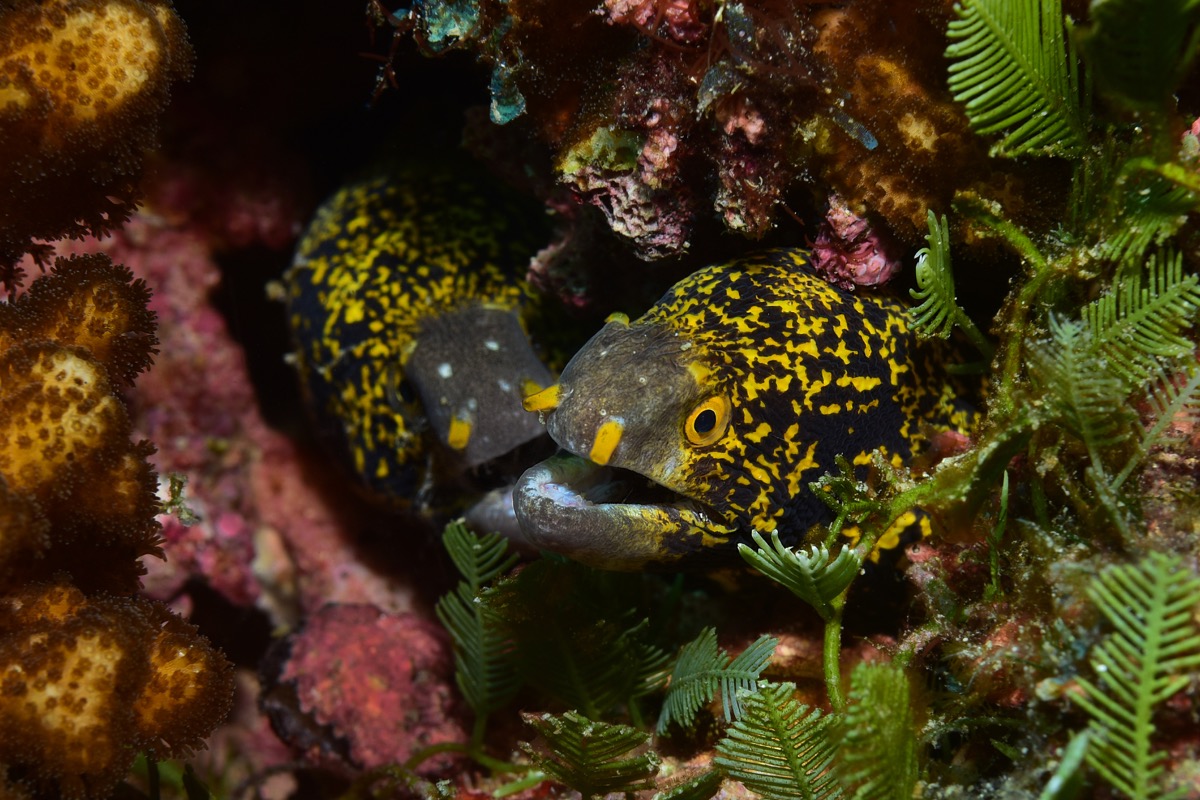
This pair of Starry Morays share a cozy home in the Sea of Cortez
Resilient!
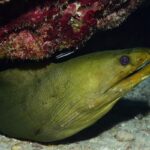
Moray Eels come in a wide variety of coloration and patterning. In addition, they have a protective, sometimes toxic, mucus which covers their skin, helping them move freely through the reef. Interestingly, Green Morays, which are often spotted by excited divers, are not green at all. Their skin is actually brown, grey and sometimes blue….it is the mucus covering the skin that gives it the green appearance!
Some morays sport solid colors, while others have intricate patterns. Yellow, green, black, mottled, spotted and striped…morays can be observed with many different looks.
Diverse!
In the Caribbean waters, invasive Lionfish have become a real problem. Introduced a number of years ago, the voracious Lionfish generally lack predators in this part of the world. Their population goes unchecked while they opportunistically prey on any and all reef fish. Their presence is adversely affecting the delicate balance of the reef ecosystem.
But Moray eels may come to the rescue because they do eat lionfish. While most fish avoid lionfish due to their venomous spines, Moray eels are known Lionfish predators and do consume them, sometimes by first maneuvering the lionfish in a way to avoid the spines. This form of natural predation may be helpful for the ecosystems being impacted by the invasive lionfish.
Important!
We have encountered Moray Eels in many of the world’s tropical waters. In Mexico’s Sea of Cortez, we photographed the Zebra Moray on the prowl during a night dive, while spotting a pair of Starry Moray Eels squeezing into a small crevice during the day. Spotted Morays are found throughout the Caribbean, along with larger Green Morays. In Indonesia, we were captivated watching a Fimbriated Moray Eel permit a cleaner shrimp to scour its mouth both inside and out! An Indo-pacific Spotted Moray grabbed our attention while diving the atolls of the Maldives. In the Florida Keys, we photographed Goliath Groupers and Green Moray Eels hanging out together in the sheltered opening in the reef, an unusual pairing of reef predators. From the Mediterranean to the Indo-pacific to the Caribbean, Morays are our constant companions on the reefs we dive on.
So now that some of the “behind the scenes” facts about these fascinating creatures have been revealed, perhaps a different level of understanding will be enjoyed when a diver in your group excitedly gestures with the universal sign for a Moray Eel, wishing they could only yell out under water, “That’s a Moray!”
Words & Photos by Michael Salvarezza & Christopher P. Weaver
-
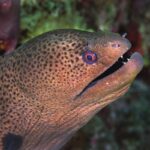
- As its name implies, the Giant Moray from the Red Sea is the largest Moray Eel
-
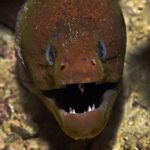
- A close up portrait of a Giant Moray Eel from the Red Sea
-
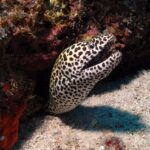
- The Honeycombed Moray from the Maldives is a strikingly beautiful creature
-
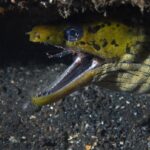
- This Fimbriated Moray is enjoying a dental cleaning from a Cleaner Shrimp
-
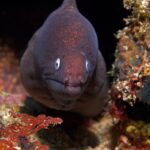
- The White-Eyed Moray from the Philippines’ Apo Reef is mostly a solitary eel
-
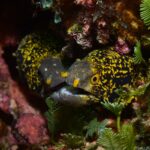
- This pair of Starry Morays share a cozy home in the Sea of Cortez
-
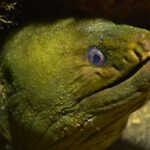
- The Green Moray Eel’s skin is actually not green but a mustard brown color
-
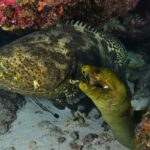
- This Green Moray Eel and a Goliath Grouper in Florida’s Islamorada are about to cooperate in a hunt
-
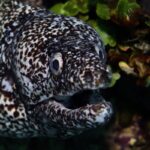
- This Spotted Moray Eel from the Dominican Republic is trying to look ferocious
-
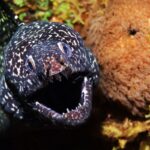
- Look closely and you can see the teeth of the pharyngeal jaw of this Spotted Moray
-
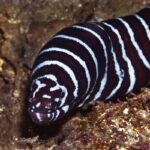
- This Zebra Moray from Mexico’s Sea of Cortez uses the cover of darkness to hunt for prey